
So, now that we have sorted out our stay in Bali in the last post, let’s get on with the Bali travel program, shall we?
First, the major exclusions
I must confess that the itinerary I planned for the southern part of the island was quite low-key, given that we were staying for only one night. We did not include Bali’s famed nightlife, nor did we opt for water sports at the beach. But perhaps the most notable exclusion was one of Bali’s key attractions – Uluwatu Temple. Blame it on my absolute terror of monkeys!
Scrolling through my Instagram feed, a visit to Uluwatu looked more like a scary adventure than a peaceful walk along the cliffside. Monkeys would pounce on unsuspecting tourists, making off with phones, sunglasses and other belongings, then demand choicest of snacks as ransom. And honestly, I wasn’t ready for that kind of mental agony on a vacation. Imagine losing my phone – my whole life is in that device! But I am sure you have none of my silliness, so do visit Uluwatu temple when you are in Bali.
On arrival day: GWK Cultural Park
One perk of reaching Bali in the noon was having the entire late afternoon and evening free to explore at our own pace. Checking into our hotel at 2 PM, we relaxed a bit and freshened up, ready to begin our Bali adventure. As I had mentioned in my previous post, our hotel was in close proximity to the newly constructed Garuda Wisnu Kencana (GWK) Cultural Park, and by 4.30 PM we were at the premises. We had booked our tickets online through Klook, which included park entry, a museum visit and performances.

The park entrance

The famous statue of Lord Vishnu on his mount Garuda, standing at a height of 121 metres (397 feet)

A statue of Garuda
The grounds of the park were expansive with beautiful statues strewed around, the most impressive being the lofty statue of Lord Vishnu on his vahana (mount), Garuda. There was, however, confusion regarding the places of interest in the park, and the paid and non-paid components, leading us to miss going up the elevator to the top of the statue.
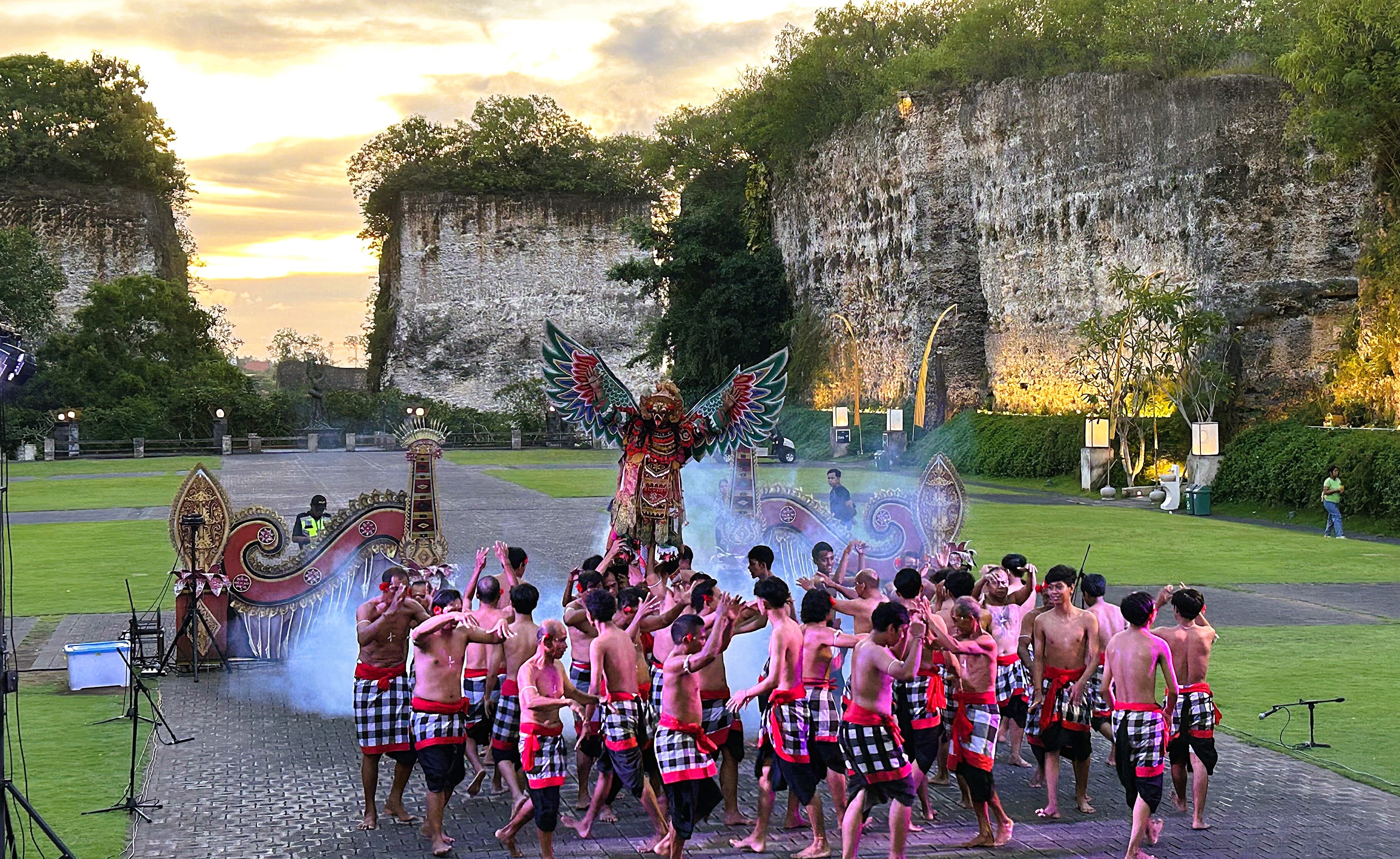
As the golden glow of the setting sun engulfed the complex, we sat down at the open air amphitheatre, ready to witness the spectacular Kecak or Balinese Fire Dance that depicts scenes from the Ramayana. It started sharp at 6 PM (a one-hour performance) and soon we were led into a trance like state with the rhythmic chak-chak incantations by the performers as they enacted stories from the ancient epic. Superbly clad Balinese dancers held us mesmerized, culminating in a dazzling finale with Lord Krishna mounted on Garuda as the showstopper. (Check the end of the post for some videos of the performance.)

The setting for Kecak dance

A beautiful performance

Scenes from the Ramayana
Post the Kecak dance, we visited the museum, which showcased the island’s rich culture, followed by another dance performance before calling it a night.

At the museum

An antique Balinese bedstead
An evening at Jimbaran Beach
Dinner, that evening, was at Jimbaran beach, reminiscent of our own Goan beach shacks. There were rows of restaurants offering varied cuisines, mainly focused on seafood. We ordered a Balinese seafood platter and were blown away by the quality of food and the flavours. The seafood, cooked with aromatic Balinese spices, came with side dishes of sauteed greens, steamed rice and a lip smacking array of dips. Definitely a meal to remember!

The seafood spread at Jimbaran beach
Day 2: Water Blow, Nusa Dua
I am always on the lookout for “hidden gems” or non-touristy places while drafting an itinerary. Why follow the same old recommendations everywhere?
While searching for a quiet beach in Nusa Dua, I chanced upon this interesting sounding name – water blow – where waves crashed into the rocky cliffside and surged out of crevices. Unsure of what exactly we would be seeing, I still decided to go on with the plan.
Checking out early from the hotel, we drove to Nusa Dua – a beautiful, posh neighbourhood replete with high-end resorts and boutique shopping. A little walk brought us to a lush green manicured garden, with a magnificent statue of Krishna and Arjuna in the centre. Buying a ticket, we entered a walkway to the oceanfront, jagged rocks surrounding us as the sea glimmered in front. There was a viewing platform at the end of the walkway and as we wondered what exactly we were supposed to wait for, we were drenched by a spray of water from an enormous wave crashing onto the rocks.

The statue of Lord Krishna and Arjuna at the complex

The walkway to the viewing platform

The clouds above and the waves below – a glorious sight!
And then the show started. As the tide increased, the waves became more frequent and huge spouts of water shot up from the nooks and crannies in the rocky crags. It was as if they were dancing to nature’s symphony, a melody only they could hear. Us being more appreciative of natural elements than man-made buildings, we enjoyed the time immensely.
Here’s a reel that we had made at the water blow site:
I remember an influencer dissing this place in her post, questioning what pleasure people find in such places. Perhaps she was at a time when the tide was low and there was no water movement. In any case, I am hesitant to recommend this place to people I don’t know well. If you decide to visit, do consult the tide timings before going there.
An under-rated beach: Geger Beach, Nusa Dua
Exiting the water blow complex, we took a short cab drive to Geger Beach, a relatively lesser known beach in South Bali. A major criterion while looking at beaches to visit in the area was to avoid the steep downward climb that was involved in reaching most of them. Ease of access played a major role in choosing Geger beach. Plus, there was no entry fee involved, something that is common in Bali’s beaches. Do check for entry points to the beach, as there seemed to be more than one.

Geger Beach on a cloudy day
Geger beach was a quiet beach, the initial part lined with loungers, with a few swimmers in the water when we reached. We followed a path by the side of the beach – resorts on the other side – and ended up in a splendid arc around it. Local fishermen sat fishing by the side of the water, while a beautiful temple came into view atop the cliff by the side of the creek.

View of the Pura Geger temple at the clifftop beside the beach
Although Geger beach mostly catered to the guests of the resorts, there were a few cafes at the entry side and we enjoyed some chilled beverages and sandwiches, just as a light shower rained upon us. Soon, we were ready to say bye to South Bali and travel to the next destination – Ubud.
Afterthought
Undoubtedly, the southern part of Bali had many more attractions to offer, which we gave a miss. But within a short period of time, we ticked off a smorgasbord of interesting sights. We visited a grand cultural park, witnessing the island’s most famous performance – the Kecak dance, we partook of the region’s seafood delicacies at the beachside, observed a natural phenomenon, and visited a pristine beach that was not known to many.
I think we did well – we managed to cover a fascinating variety of sights in Bali in the first few hours.
Here are some videos of the Kecak dance:
Hear the chak-chak chanting? The performance uses only human voices to narrate its story
The grand finale!
Coming up: what’s next on the itinerary!
Read the first part of the Bali series here:


Leave a Reply