
Some birds, like people, are special. Not because they are gorgeous or difficult to spot, but because they hold our fondest memories, those that awaken a bittersweet longing to return to another time. I was sitting in a bird hide in the Sharavathi valley, watching a bold Malabar Whistling Thrush lead a parade of beautiful birds, when memories of bygone days gently stirred and rose to the surface.
The Bathing Beauty
Having spent a small part of my childhood in Manas National Park, in the north-eastern Himalayan foothills, away from the drudgeries of school, I would mostly busy myself with storybooks and observing the world around me. Which, more or less, happened to be the scene outside our bungalow window.
Deta, as I called my father, loved aesthetics. His library would have several books on gardening, one of which was a beautifully illustrated copy on Japanese gardens, a favourite of his. Perhaps the images from that book, and others, led him to design two small ornamentals ponds on both sides of the garden path. In the shallow pond, he planted water lilies, and in the deeper, he grew lotus. He released a few guppy fishes into them, and we took great delight in looking for them under the leaves.
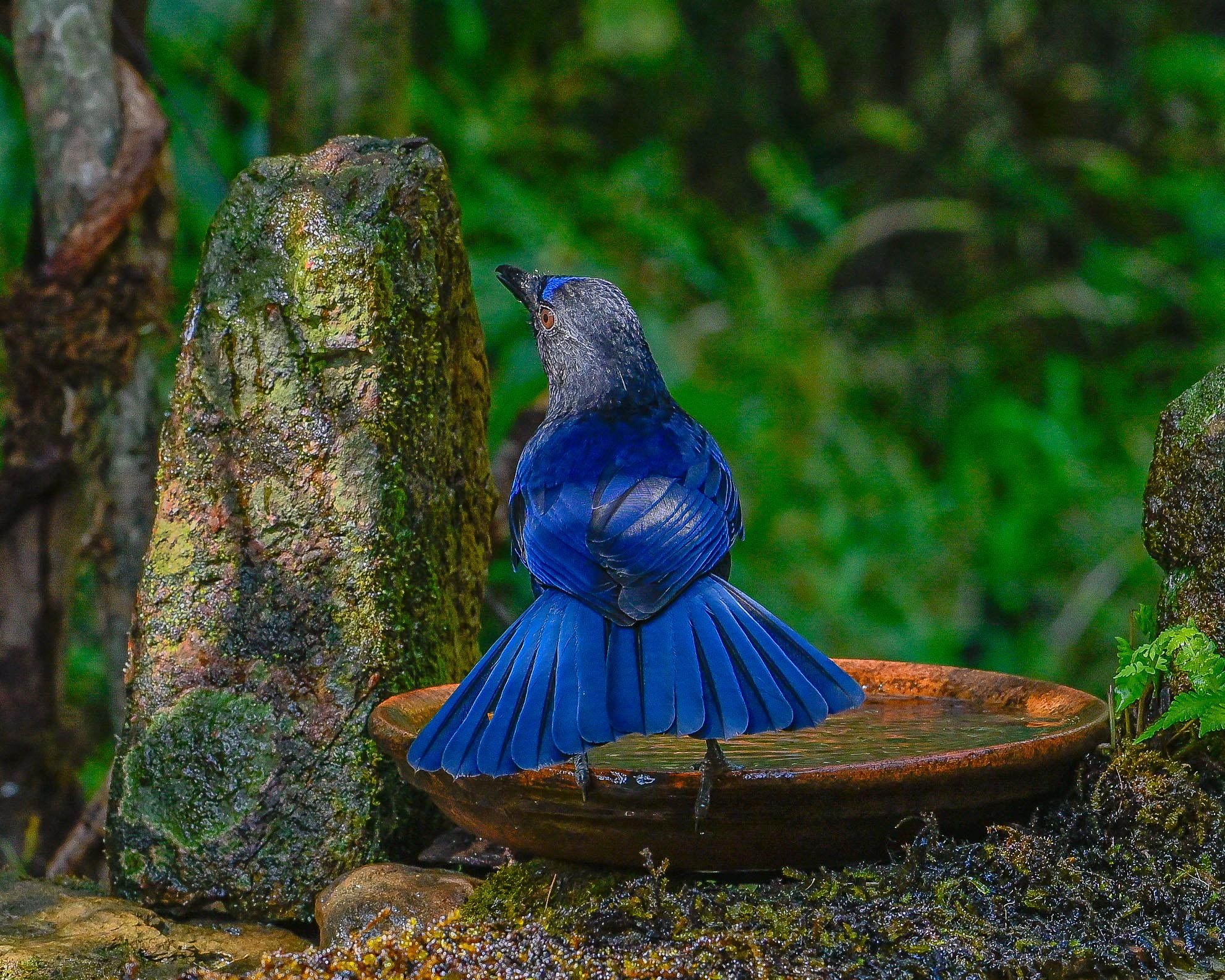
The window of my room opened out to the lily pond, and it is there that one day I saw the most beautiful blue bird of my life. It appeared out of nowhere, perched itself by the pond for a while, scanning the surroundings before stepping into the water. Under the glorious morning sun, it spattered glittering droplets of water as it bathed. With dark blue feathers – almost bluish black in hue, tiny electric-blue speckles on its upperparts and a bright yellow beak – the Blue Whistling Thrush was a beauty to behold.

I described the bird to Deta and learnt its enigmatic name. A Blue Whistling Thrush! It whistled? The thought piqued my young mind. That night I wrote about it in my diary that Deta had given us sisters to note down the highlights of the day. Soon, waiting for the bird every morning became a part of my daily routine.
Yet, to my disappointment, I never heard it whistle.
The Ones Up North
During my readings, I came upon stories written by the eminent author Ruskin Bond, most of them based in the misty hills of the north. In those delightful tales woven against a backdrop of nature, I recognised the name of the blue whistling thrush. A particular ghost story involving a whistling schoolboy who would appear out of the fog somehow reminded me of the thrush.
Decades later, in 2021, I made a birding trip to Uttarakhand and there I bumped into the blue bird of my childhood again. This time, I heard it sing.

I found the bird roaming casually around the places that we visited, much unlike the alert, skittish blue thrush I had witnessed in our lily pool. Our mornings would start with its meandering whistle of a song and, intermittently, through the day, we would see it perched here, or foraging there. We managed to catch a sight of it even in the high altitude of Tungnath, scouring for titbits amidst the remnants of snow. Being omnivorous, its diet includes small invertebrates as well as plant matter, as it prefers to inhabit areas near rocky streams and forest edges.

The Southern Cousin
Much before I came upon the whistling thrush in Uttarakhand, I had become acquainted with its cousin in the Western Ghats – the Malabar Whistling Thrush. The first time I heard its song was on a weekend getaway from Bengaluru to – where else but Coorg. In fact, as a new birder then, it was the first time I had heard its hauntingly beautiful whistling tune.
“Is that our caretaker whistling so early in the morning?” I remember asking the husband groggily.
Interestingly, the whistling seemed to come from our balcony, and there was no way the caretaker of the homestay could have accessed it. As I parted the curtains, a bluish-black bird flapped away mid-song. Childhood memories came rushing back, and I instantly knew it was the southern counterpart of its Himalayan cousins.

Since then, I have managed to hear its song on every trip to the Western Ghats — from homestay backyards in Goa to coffee estates and forest lodges in Karnataka and Kerala, catching a sight of it even in the crowded Nandi Hills near Bengaluru. A particular monsoon holiday in Coorg will always remain special, for this bird entertained us unfailingly in the mornings and afternoons, just as the rain provided the perfect background music to its song.
Here’s a snatch of the video where I tried to record its song:
Though closely related, the Malabar and the Blue Whistling Thrush are distinct species, each endemic to its own mountain range. Unlike its counterparts in the north, the Malabar ones are extremely shy birds and although you might hear its song, you might not actually see it. A glossy black body, offset by a cobalt-blue patch on the shoulders and forehead, sets it apart from the other.
Another interesting note is that while Ruskin Bond’s stories hint at similarities between the Blue Whistling Thrush’s song and that of a schoolboy, it is the Malabar Whistling Thrush that is better known today as the “Whistling Schoolboy” because of its musical, somewhat rambling call that closely resembles a schoolboy’s carefree tune. My son insists that the Malabar thrush outshines its northern relative by a mile in melody and is absolutely deserving of the epithet!


That day, as I followed the movement of the Malabar whistling thrush in the bird hide, just as I had years ago in Manas, admiring its almost peacock like strut, the tail flipping open like a twirling skirt, its dips and bows – I realised how incredibly lucky I have been. In a world where bird species were vanishing rapidly with the depletion of their habitats, this bird had managed to survive through the years. In both the Himalayan foothills and the Western Ghats.


So, have you seen any of these whistling thrushes yet? Have you heard its beautiful song? Let me know your thoughts!


Leave a Reply