
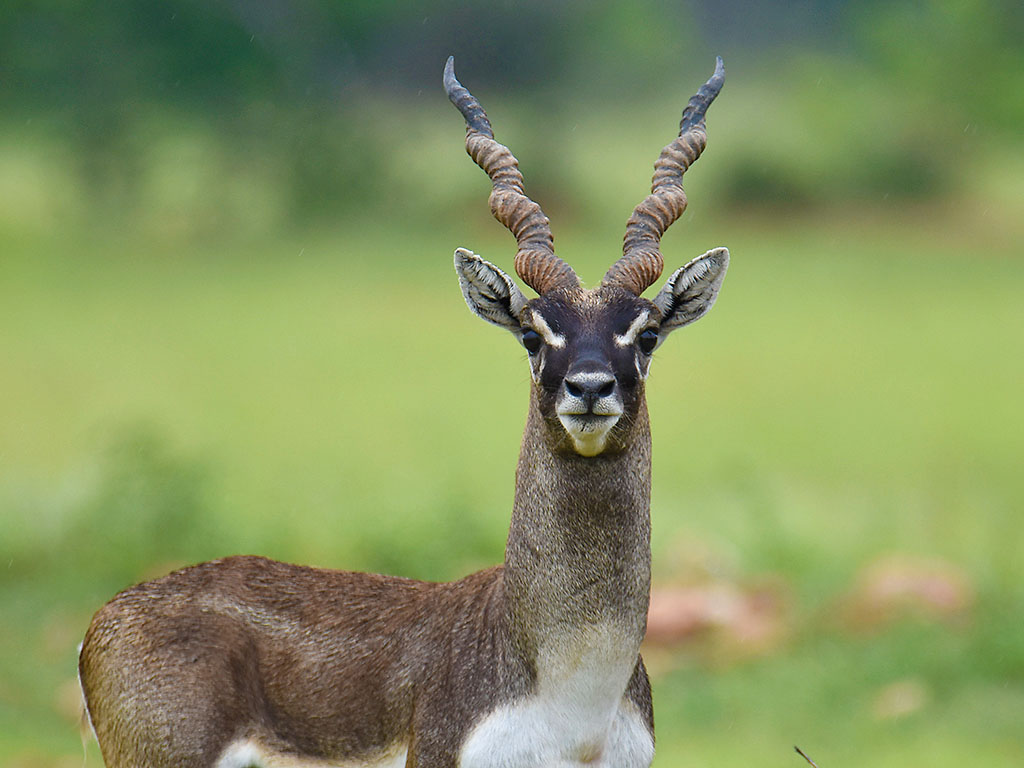
While posting my previous article on Jayamangali Blackbuck Reserve, I realised, a little too late, that in my overzealousness I had written only about the birds there, completely ignoring the key protagonist for whose conservation the sanctuary was established – the blackbucks. While not endangered presently, the blackbuck’s story reflects sustained conservation efforts, following decades of decline due to hunting and habitat loss.
The Jayamangali Blackbuck Reserve spans approximately 798 acres of grassland habitat. Notified as a conservation reserve in 2007, it remains the only protected area in Tumkur district. Though relatively small in size, it hosts one of the largest contiguous populations of blackbucks in Karnataka, second only to the Ranebennur Blackbuck Sanctuary, along with a rich diversity of birds, mammals, reptiles, and butterflies typical of dry grassland ecosystems.
Thriving or Threatened?

Once you reach the dirt road leading to the sanctuary, it takes a while for the eyes to adjust to the grasslands and pick out the camouflaged wildlife. In the early hours of the morning, solitary blackbucks would come into view at first; then, following their line of sight, an entire herd would gradually emerge. As the light strengthened, they appeared more frequently and in greater numbers. Given the harsh sun, the blackbucks would mostly be active in the mornings and late afternoons when it is cooler, retreating to shaded vegetation during the day to escape the scorching heat. Interestingly, we have always found them outside the reserve’s gates than inside.
Another intriguing aspect we observed was their group formation. At times, an entire herd would solely comprise tan-coloured young males (adult males being distinctly darker), while at others it consisted only of females and their fawns, with a formidable male standing guard as their escort. It is delightful to watch the juvenile males engage in playful mock fights, perhaps rehearsing for future battles over mates or territory.

Blackbucks can breed year-round, though most fawns are typically seen in the months following the monsoon, when the grasslands are lush and nourishing. Once, I remember my father was pleased to see a mother with two fawns.
“It is quite uncommon to see a blackbuck giving birth to twins,” he had said. “Perhaps they are receiving adequate nutrition here, or maybe the survival conditions are good.”

At that time, around 8 years back, we hadn’t heard of any incidents involving large predators. Now, however, leopards have reportedly been sighted in the area, though I feel the greater threat comes from elsewhere.
Over the years, we have visited the region at various points of time and each time the landscape somehow seems altered. Agricultural plots have come up in the grassland where there were none, previously. Electric fencing have been put up to restrict the animals’ movements. The number of feral looking dogs seems to have increased in inverse proportion to the blackbucks’.

For a long time, the undergrowth grew unchecked, with dried, thick, matted grass covering the land and preventing fresh growth, which threatened to reduce forage for blackbucks and obstruct suitable habitat for birdlife. Thankfully, on our recent visit, we found that some parts had undergone controlled burning to encourage the growth of new grass.
Beyond Birds and Blackbucks
While Jayamangali/Maidenahalli has always been a haven for birds and blackbucks alike, we were fortunate enough to encounter other wild beings as well — a reminder that an ecosystem capable of sustaining such species also provides vital support for many others.
Once, we were trundling along towards the reserve’s entrance when suddenly a dog-like animal caught our attention. Looking closely, we realised that it wasn’t one of the village dogs but a Southern Indian Jackal, sauntering casually by the roadside. It gave us a disdainful stare as we stopped to click its picture, before disappearing into the bushes.

Another interesting sight was of a black-naped hare that we had stumbled across on our very first visit. We were on foot, exploring the area near the gol ghar type resthouse when a rustling noise made us turn around. My heart leapt into my mouth as I came face to face with a hare, almost at eye level, catching the fellow mid-air in his sprint. In three giant leaps, the bouncy chap vanished from view, before we even could recover from our stunned surprise.
On another occasion, we came upon a charming little creature, one that was a common sight in our childhood. We had just had our lunch at the resting place and were driving out when this feisty Indian grey mongoose stopped us on our tracks, standing upright on his feet, ears alert. At that moment, it looked incredibly comical yet adorable, reminding me strongly of Rikki Tikki Tavi, the brave little mongoose that fought two cobras from Rudyard Kipling’s The Jungle Book – a story we had read as part of our school syllabus.
“It looks like Timon, the meerkat,” my son declared. On second thought, it did look as though the mongoose was masquerading as a meerkat!

Speaking of snakes, on one of his solitary sojourns my husband once spotted a magnificent rat snake coiled atop an earthen mound, basking in the winter sun.

The Other Side of Development
It is because of these wonderful sightings, of myriad species of birds and wildlife, that Jayamangali remains one of my absolute favourite places to visit near Bengaluru. Yet, with every visit, my heart aches a little to see the latest developments: a plot of land cordoned off here, another patch claimed there. More vehicles pass through, more dogs roam about — signs of expanding dwellings in the region. How long till the blackbucks run out of space to graze?

Also, while this may be the way of nature, it is still saddening to watch birds and animals search for water during the relentless summer months, when the water bodies run dry. Perhaps the small man-made pools could be replenished, just to offer some relief to these dehydrated creatures.
The Finale
We always wait until the sun sets in Jayamangali, for that is when the reserve unveils its finale: the blackbucks’ final performance of the day as they cross the road to the other side. Moving in tandem, they gradually gather speed and, in signature style, spring effortlessly over thorny bushes.

It is a magnificent sight, that of the silhouettes of blackbucks against a sky turning crimson. If only this spectacle could continue undisturbed, the world would seem a little more in balance.
PS: In case you missed my previous article on Jayamangali:


Leave a Reply