
(Continued from the previous part)
We had gone on a short weekend trip when the nest was nearing completion, reaching home late in the evening. The next morning, after the husband had left for office, I gently approached the nest.
What I saw thrilled me to bits – the female purple sunbird was sitting inside the nest! She must have laid eggs and was brooding.
“We are going to have babies soon,” I texted my husband excitedly. “Well, congrats, grandma,” my husband texted back.
I was an intense grandmother, if there ever was one. I guarded the balcony fiercely, making sure that nobody went near it. We began drying our clothes in the utility area, leaving the balcony entirely to the sunbird couple. My husband would cautiously venture out to water his plants only during the intervals when the bird went out for food. Our activities amused and annoyed my in-laws in equal measure, now that the balcony was off-limits for them most of the time.
Two weeks passed, and we still didn’t know if the babies had hatched. I thought there would be a stream of baby chirrups coming from the nest; instead, it was absolutely quiet. I would surreptitiously try to peep into the nest while the bird was away but the flap at the mouth of the nest blocked any view of the inside. Doubts creeped into my mind, what if something happened to the eggs and they failed to hatch?
On the 17th day, we spied the female sunbird fly to her nest and perch herself at the mouth, putting her head inside the nest for a few seconds, and fly away again. Surely, she just fed her babies! Soon, the male flew in and he, too, did the same thing. We let out a massive sigh of relief – we had sunbird babies in the house!

For the next two weeks, the parents kept up a frantic feeding episode, each taking turns to bring food to the hatchlings. I observed that there was a method that they adopted. The bird would not fly to the nest directly, but it would first announce its presence with a loud chirp, perched at one of the plants in the balcony. It would continuously keep chirping till it gathered confidence that it was safe to fly to the nest. I suppose this was a preventive step to deter predators from spotting their nests and endangering their young.
Sometimes we would be watching a TV program when the parents were carrying on with their feeding session, and their loud admonitions would make us move out of their direct line of sight. “Can’t even sit in my favourite spot in peace,” my husband would grudgingly remark while changing his seat. “There, are you happy now?” His comments always had me burst into laughter.
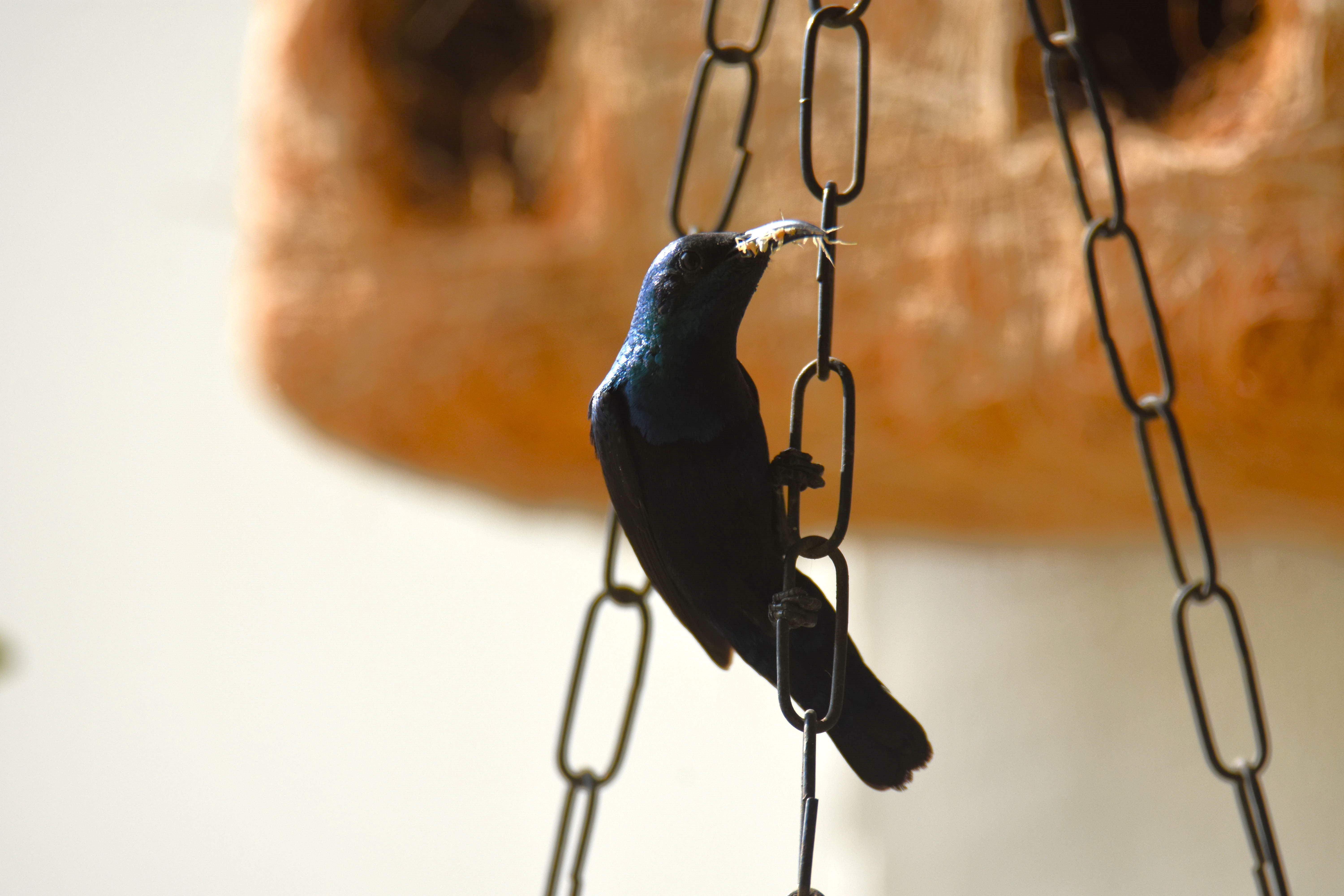
I was curious to see what the parents fed their babies. Zooming into the photos that we once clicked of the birds, we noticed them carrying mouthfuls of tiny bugs and spiders in their beaks.

The parent would regurgitate the food to feed, and also clean up by carrying away the fecal sacs, just like tiny white diapers. What a neat household they kept!
There would be a lull in the feeding session in the afternoon, usually between 12.30 pm to 3.30 pm, when perhaps they rested a bit from their hectic duty. Come evening, the mother would take her place in the nest, her head sticking out like a sentry. Looking at her solemn profile – a dark silhouette comprising a pair of beautiful eyes and a hooked beak, I couldn’t but help admire her boldness and tenacity in bringing up her children.
For me, that image of the mother purple sunbird will remain forever etched in my mind: sitting upright in that tiny nest with her babies underneath her wings on dark nights, in a stranger’s balcony.
“There are two babies, Mumma,” my son told me one day. “One is a weakling. He doesn’t get to eat much, the other one pushes him aside.”
Read Part 3 here:



Leave a Reply