
Last year, after two decades of working in the real estate industry, I finally decided to take a break. It was a difficult decision and I wondered if I had done the right thing as I sipped my morning cup of tea in the living room, facing our little balcony – my first cuppa on a weekday, that was not at my office desk. It was just then that a tiny, iridescent purple sunbird chirped its way into my life.
I have an overflowing balcony, filled with numerous pots, plants and climbers jostling against each other, in my zeal to create the garden of my childhood home in Assam. Every now and then, we are led to untangle our clothes from the plants as we put them out to dry in that multi-purpose balcony space. Real estate is precious, ask me.
I noticed that the sunbird was visiting our beautiful dischidia plant, something that I hold close to my heart as it was gifted by my dad, from his garden in Assam, before he passed away unexpectedly due to Covid-related complications. The hanging plant was in bloom, bearing tiny white bud-like flowers. The sunbird deftly began feeding on nectar from each bud, hopping and swinging from one stem to the other, chirping mid-way through the meal. I sat mesmerised at the performance; my tea forgotten.
Soon, it became a ritual. I would say goodbye to my school-going son and office-going husband, and sit with my chai, overlooking the balcony. Without fail, my little guests would appear – both the deep purple clad husband and the dull olive and yellow wife. In many ways, the sunbirds are the hummingbirds of the Indian sub-continent. They are small, restless, feed on nectar, brightly coloured (males), and fairly resemble the American counterparts in appearance. But unlike hummingbirds, sunbirds don’t hover while feeding. While around 145 species are found across the world, India is privy to some 12 species.
I would sometimes take photos and videos of the sunbirds and send them across to my husband. “How I wish they nested here,” would be my regular refrain. Already, I had heard of birds such as scaly-breasted munias and dusky craig martins nesting in our neighbours’ balconies who lived on higher floors. Envy would creep up each time one of them mentioned ‘their birds’. Maybe they felt insecure on lower floors, I thought. Maybe they needed privacy.
And so, the next time we drove to Coorg, I bought two bird houses made of cardboard and coir/straw. Till date, they are empty. Except the red-whiskered bulbuls, who visit the bird houses to steal nesting material, the scheme has been a total flop.

A year passed by, watching the sunbirds visit our balcony. I kept out bowls of fresh water and bought flowering ixora plants to provide them with nectar. My hopes were diminishing but at least I could watch them from close quarters every day – the distance from my living room sofa to the balcony was merely 8 feet, separated by a sliding glass French window.
And then it happened. On January 24th, this year, the purple sunbird couple started building their nest in the dischidia plant.
It started out quite subtly, the female sunbird returning to the plant at short, frequent intervals. For a while, I thought she had come to feed. Slowly, realisation started to sink in.
“Is she…is she building a nest?” I whispered fervently to my husband. I couldn’t believe my eyes. It really was happening! My manifestation was coming true at last.

I sat rooted to my living room, following the activity of the sunbird couple as they zoomed in and out of the balcony, unperturbed by my presence. Interestingly, the nest building responsibility rested solely on the female, although the husband would perch close-by and chatter out loud encouragement (or what seemed like rapid scolding at times, in case she lagged).
“The husband is rounding up his wife and bringing her back to work,” I would text my husband gleefully, observing the family drama. First time parents? The thought crossed my mind.
Yet, the female sunbird would expertly weave together all that she brought in her beak, tying them up securely to the stems of the plant. When there was a lull in building activity, I would sneak out to marvel at her skill – birds are indeed the original builders and architects of the natural world.
I could see that a lot of calculations went in while building the nest. The sunbird would firmly tuck in the nesting material, give little jumps to see if the structure held, and stretch out her wings to measure out if the space sufficed. In short, she was the toughest quality control officer there was of her own work.
In five days, the nest was ready.
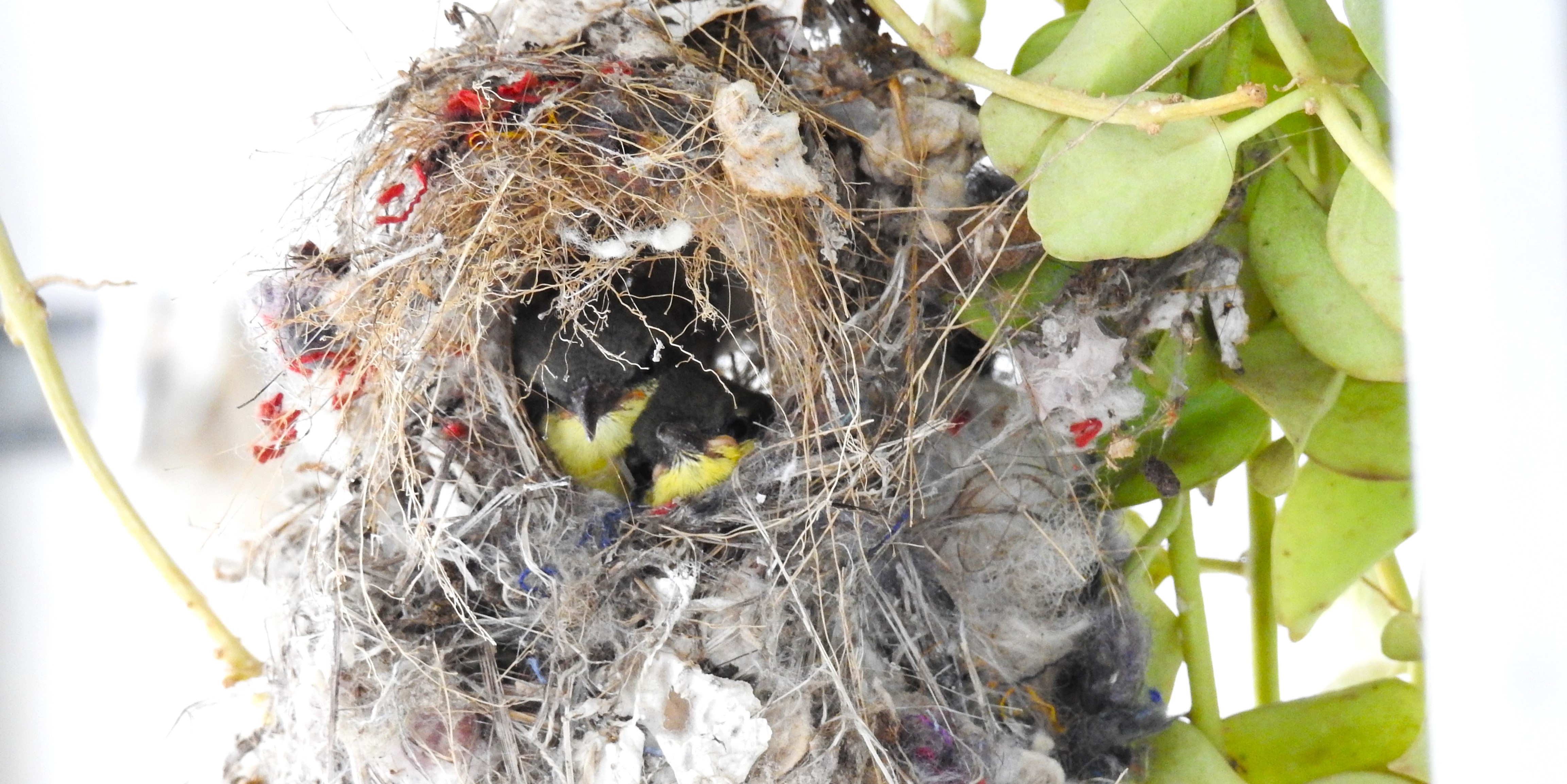
The tiny, pouch shaped nest was meticulously made out of wisps of fabric, downy feather, wool, dried leaves, grass, and loose broom discards, amongst other materials. The most interesting, and clever, part was the flap that obstructed direct view of the nest’s mouth. There was no way to tell if the bird had laid eggs, or how many.

Read the next part here:


Leave a Reply