
It was on a sultry April morning that we reached the coffee town of Sakleshpur, dark clouds and intermittent light showers accompanying us along the way. A sweet black dog stretched, yawned and welcomed us as we pulled into our homestay Mugilu. We were there just for one night, seeking some fresh air and a short respite from the city hubbub. Of course, we were hoping to do a little bit of birding, even though the migratory season was over.

Lesser whistling ducks and Indian spot-billed duck in a water body enroute Sakleshpur
As we trundled towards our accommodation, a flying draco took off from his perch and landed straight into the arms of his lady love in an adjoining tree. Well, figuratively.
We had heard that Mugilu was a favourite haunt of birders, thanks to its resident celebrity — the Malabar Trogon. True to its repute, we heard the trogon’s call just as we were checking into our cottage. Needing no further prompting, my husband and son rushed out with their cameras, leaving me to settle our things in the room.
As I fought the temptation to lie down on the inviting bed, my phone rang urgently.
“Come!” my husband whispered fiercely over the phone. “The trogon is here.”
As I tumbled out of the cottage, another trogon’s call sounded overhead. Craning my neck upwards, I was barely able to make out its silhouette as it flew past with a flutter.
The husband and the son, meanwhile, was having a field day with a male trogon in another part of the estate. Although it wasn’t an easy task to get a clear sight through the dense foliage, the bird sat patiently till I showed up and had my fill of viewing, too.

Malabar Trogon
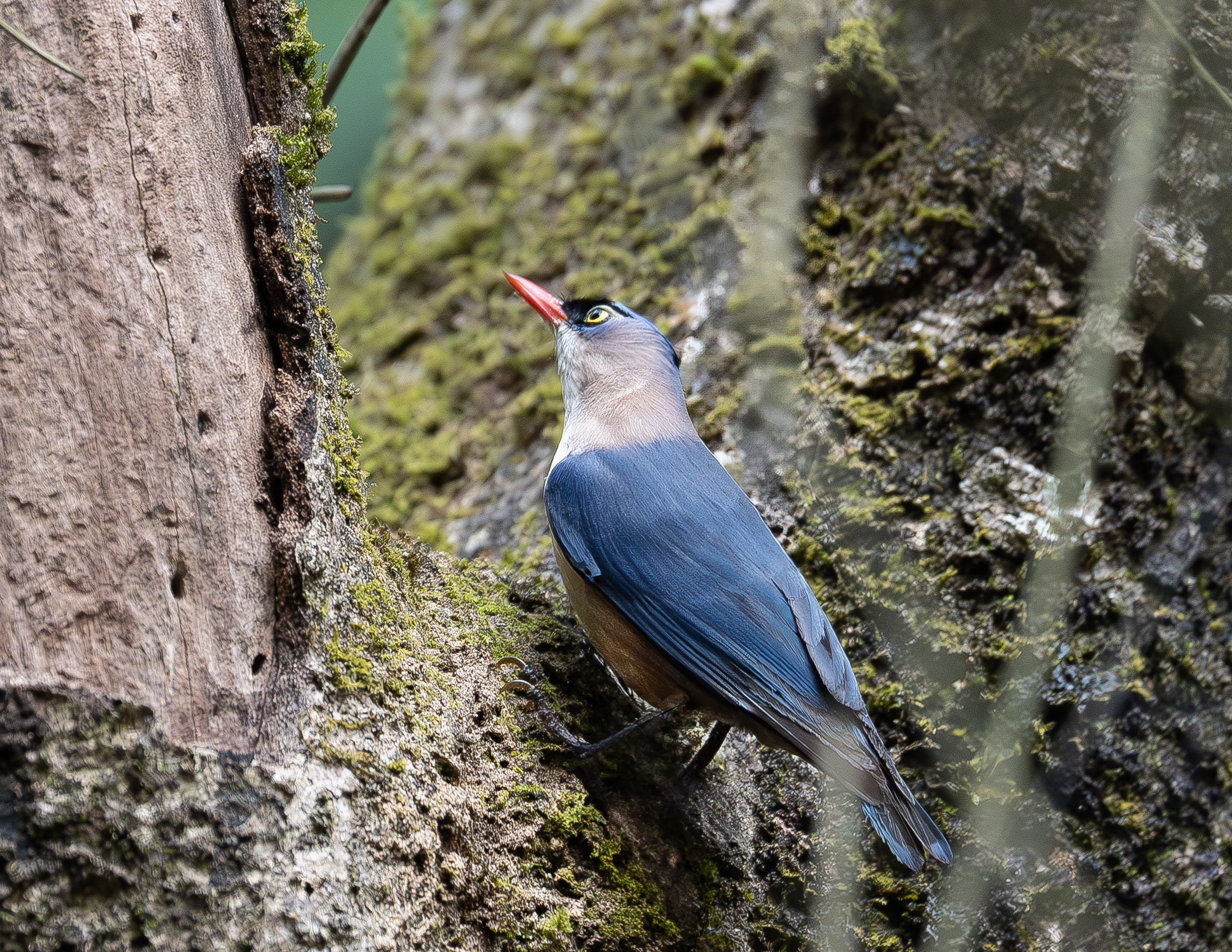
Later, as I snoozed in the room, waiting for lunch to be served, the husband went on a solo jaunt around the homestay’s premises. He came upon a host of endemic Western Ghat birds, including velvet-fronted nuthatches, rufous babblers and white-bellied treepies. Hearing him rattle away the names, I quietly regretted my decision to sleep.

White-bellied Treepie

Velvet-fronted Nuthatch
The afternoon was extremely humid owing to the gloomy sky. We sweated bucketloads on our walk around the property while a few leeches clung to us, taking advantage of our frequent halts. The calls of Malabar Grey Hornbills startled us from time to time, their loud voices always reminding me of a coven of witches gathered around a bubbling cauldron, cackling away toothlessly. After a while, finding the usual suspects — jungle babblers, racket-tailed drongos, and barbets — vocalizing raucously, we called it a day and put away our gear. As we prepared to sleep after a delicious meal, a brown wood owl near our cottage bade us goodnight with its deep call.

Malabar Grey Hornbill

Rufous Babbler

Racket-tailed Drongo
The next morning we woke up to find ourselves shrouded in a thick swirl of mist. With low visibility playing spoilsport, we decided to stay in till the mist lifted.
At around 8.30 am (late by birding standards), we ventured out of the homestay and found ourselves in the midst of a feeding frenzy at a fruiting fig tree near the homestay’s gate. Barbets, both Malabar and white-cheeked, jostled with red whiskered bulbuls and magpie robins to have their share of the breakfast spread.

Malabar Barbet

Grey Wagtail
Leaving them at their meal, we moved forward and soon found ourselves in a beautiful meadow, dewy spider webs gleaming like jewels on the ground. Pipits and larks were making brisk business of catching the early rising worms, while bee-eaters – green and chestnut headed, both – whirled overhead snatching dragonflies mid-air. The mist hung low over the meadow; even as thin rays of the sun strove to penetrate through the dark clouds.


A misty morning at the meadow
Power lines went across the area, and while scanning a tall tower for any bird activity, our glance rested on the familiar silhouette of bird perched quietly. Peering through the binocs for a moment, I was taken aback by the identity of the bird.
“It’s a Shaheen Falcon!” I cried.
While the Shaheen Falcon (Falco peregrinus peregrinator) is a subspecies of the Peregrine Falcon (Falco peregrinus), it can be easily distinguished by its darker, warmer-toned appearance and rufous-tinged underside.
Unfortunately, the sky was still gloomy, and the backlight didn’t make it any easier to photograph the falcon. We had to satisfy ourselves with a dark, grainy image of this lifer species of the trip. We were willing to wait it out until the daylight brightened, but a feisty little ashy woodswallow appeared out of nowhere and began mobbing the falcon, causing it to fly away. What cheek of that tiny bird!

A record image of the Shaheen Falcon
With the Shaheen disappearing in the hillside, we continued our walk, this time on the opposite side of the track, past the fig tree. A racket-tailed drongo ran through its repertoire of mimicry and songs, until we realized it wasn’t several birds, but just one clever drongo leading us on a merry dance. Rounding a bend, we suddenly came upon a burst of bird activity. Loten’s sunbird, small minivets, and flowerpeckers were flitting from bough to bough, each busily foraging — the sunbird sipping nectar, the flowerpecker mouthing tiny fruits, and the minivet catching flying insects. It was a wonderful sight, offering a glimpse into the feeding habits of species.

Small Minivet (female) with prey

Loten’s Sunbird (female)

Small Minivet (female)
The sun was truly out by then, and we decided to return to the homestay for breakfast — but not before spotting a huddle of Malabar Grey Hornbills, cackling gleefully from the canopy of a tree.
With breakfast done, our whirlwind of a trip came to an end — the time seemingly flown by in a blink. Our birding kitty, however, was by no means a modest one, especially with a lifer thrown in. Short and sweet — that’s how I would like to remember our trip to Sakleshpur.
As we drove out, we spotted our welcoming committee member lounging cozily on the guard’s bed, enjoying the cool shade of the room. Perhaps another visit is due in winter, when the birdlife will be more plentiful and the weather more pleasant. Till then, here’s to more birding in the days to come!

Malabar Grey Hornbill


Leave a Reply