
Every morning, I would arrive at my office, plug in my laptop, and wait for the sunbathers to show up at the windowsill. My office building was one of those modern structures, its length mostly lined with glass windows, shielded by blinds from the sun. Although situated bang in the middle of a busy intersection on MG Road, Bengaluru, the view from the top floors showcased a wonderful side of the bustling city – a lush green expanse juxtaposed with high rises on the horizon. A little ahead lay the shimmering waters of Halasuru lake.

Beautiful Bengaluru
One of the first to show up at work, I cherished those few minutes of solitude. The gentle morning rays would slowly seep in through the windows, throwing long golden rays across the room. And just then, you would hear their song.
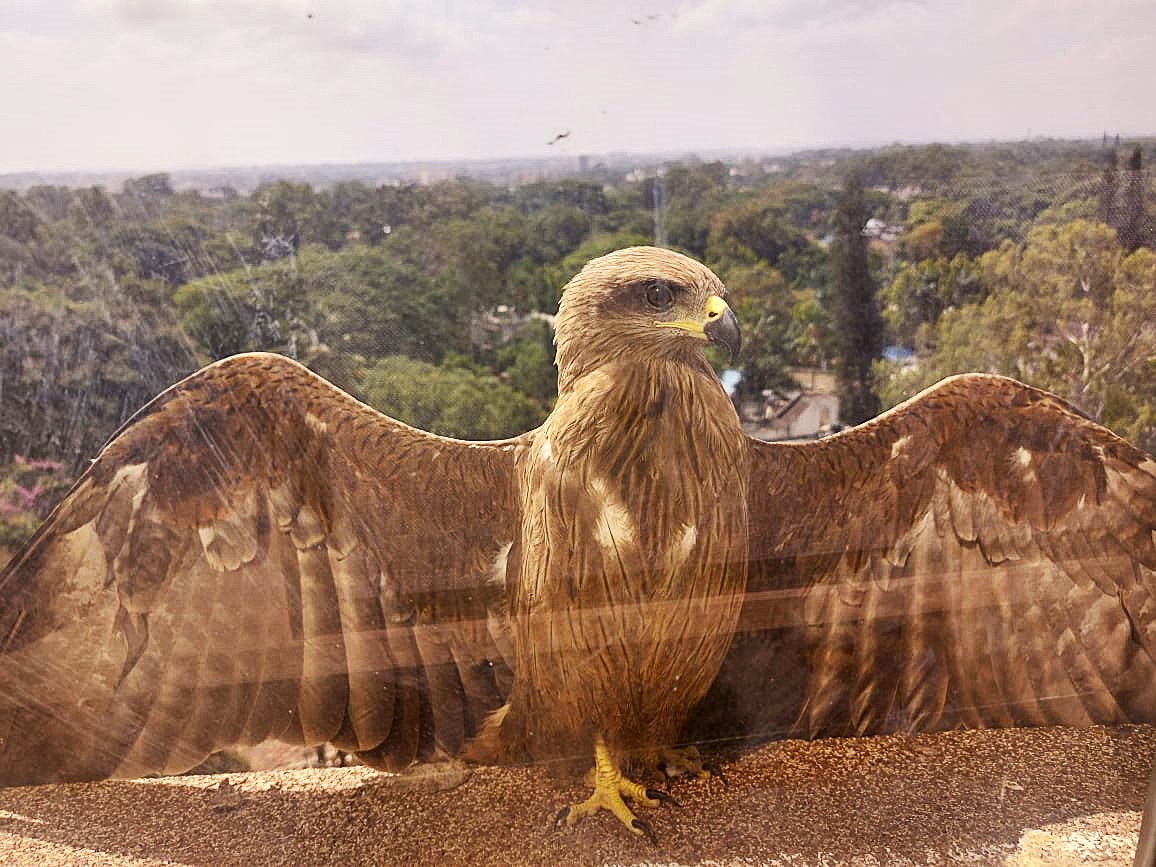
That would be one of them — either the black kite or the Brahminy kite — whichever was the first to arrive.

Black Kite

Grainy imange of the Brahminy Kite
They would perch along the ledge, spread out their wings in the sun to soak in the warmth, and let out melancholy cries. The glass being reflective, they couldn’t see me on the other side. It was an odd one-sided relationship that we shared — each of us lost in our own reveries, separated by the glass pane. After shaking off the morning chill, they would fly off to start the day, and so would I.
The kites would return again in the late afternoon, though never together.
“Your friend is here,” my colleagues would announce.

By then the office would be a humming zone of worker bees. If only they could see through the glass, they would have chuckled out aloud.
My previous job, before the MG Road one, was located on Infantry Road – another busy business hub. The building was an older structure, overlooking a beautiful tree lined avenue, chock-filled with traffic chaos. Yet, once you were in the office, you would find yourself surrounded by frangipani, fig, tamarind and mango trees with sweeping branches, the latter bearing bountiful fruits in the summer. That part of the city belonged to the Bengaluru of yore. Sometimes, to escape from reality, I would imagine that I was sitting in the midst of a fruit orchard.
Once, my colleague, who knew about my birding hobby, rushed to my side.
“There’s a beautiful bird out in the balcony,” she gushed. “Come and see!”
It turned out to be a gorgeous Indian Golden Oriole.

Indian Golden Oriole
Some days, I would spot a white-cheeked barbet, calling out enthusiastically to another one in the vicinity. On other days, I caught sight of tiny pale-billed flowerpeckers flitting from branch to branch, pecking away at the small fruits of the Singapore cherry trees in the premises of the building next door. As if that weren’t enough, a black kite began building its nest just outside my office window. Each evening as I left, it became a habit to glance up at the tangled mass of twigs, searching for signs of its young ones.

White-cheeked Barbet
Unbelievable, when you consider the amount of urban development around. Yet that small oasis of greenery supported a thriving birdlife in the city.
Adjust and adapt – the mantra
In an environment that’s become increasingly polluted and unsuitable even for humans, it’s nothing short of a miracle to spot these birds in the central business district of the city. The fact that they have adapted to the vagaries of city life, is another wonder. Today, examples of such adaptation are becoming evident across several populated cities in the world. Think New York City and its falcons, Singapore and its Javan Mynas, and the list is growing. Perhaps it’s the sheer willingness on their part to survive that has led them to adjust their feeding and nesting habits.
A recent study by the Indian Institute of Science revealed that in the last five decades, 93 percent of Bengaluru’s lake and forest cover has been replaced by concrete structures, depleting the habitats of many species of birds and forcing them to make drastic shifts in their behaviours. I remember reading about a few black-crowned night herons in a congested part of the city, feeding on rodents instead of their usual diet of aquatic animals and insects. A sad state of affairs for a city whose climate and natural surroundings are otherwise conducive to supporting such a wide variety of avian life.
I no longer work at the MG Road office. Yet, every time I hear the pensive call of a kite, I am reminded of my morning routine with my coffee companions. I miss that close proximity to the birds I once only saw soaring high in the sky — who then perched right across from me on the windowsill. I hope they still make their visits to the office, offering the same thrill and companionship to someone seeking a break from the monotony of life.
Brahminy kite calling
PS: I have refrained from mentioning the most common urban birds – the rock pigeons. Because, well, let’s just say I wouldn’t invite them to a party — even if they brought snacks!


Leave a Reply