
Galibore Nature Camp, nestled in the Cauvery Wildlife Sanctuary around 180 km from Bengaluru, is one of the few places near the city that never ceases to amaze us. Over the years, we have paid several visits to the camp run by Jungle Lodges and Resorts (JLR), and each time has been an even greater experience than the last. I had previously written about my visits to Galibore in a blog that is, sadly, now defunct, including that memorable incident when our car had broken down in the middle of the jungle, far away from the camp and out of mobile range. Too bad I lost my older posts along with years of blog content. But let’s make fresh memories, and I hope to hold onto all my reminiscences of birding in this beautiful stretch, with or without my blog posts.
This year, in January, we decided to spend our 15th wedding anniversary at Galibore. Last year, it was at Gopinatham Mystery Trails, another gem of a place. Somehow, each of our anniversary trips have turned out to be birding bonanzas – enough to make our day special!
Feeding frenzy at the entry gate
It has always been our habit to reach the destination as early as possible so as to have the entire day at our disposal, and also to acquaint ourselves with the awakening birdlife. Our past visits had revealed that the entry gate to the Galibore Nature Camp was a hotbed of bird activity, particularly in the early morning hours.
We were not disappointed. Within the span of just 15-20 minutes, we spied a flurry of tiny birds, each diligently embodying the proverb, “The early bird catches the worm.” Amidst the feeding frenzy of drongos, small minivets, magpie robins, warblers, pipits, wagtails, flowerpeckers, woodpeckers, and the raucous babblers, there stood out the rare, white naped tit – a vulnerable species that’s found only in a limited range, the Cauvery Wildlife region being one such location. We had spotted it quite by chance in a previous visit in the same area, and later at the Gopinatham property.

White-naped Tit

Indian Roller
A little away, hidden by tree canopies, sat a flock of European bee-eaters – passage migrants that winters in the Cauvery region for a short period of time. The morning fog had not lifted entirely, and we had to strain our eyes hard to make out the otherwise brightly coloured birds, bunched up in tight groups atop the tree. Interestingly, we had seen our first European bee-eaters in the same region, around a decade back, during our early years of birding.

European Bee-eaters
A jungle in fatigues
Leaving the birds at their breakfast, we drove towards the camp through the kachha, unpaved road – something that I always found attractive. It provided the right “wild, untamed” vibe.
Monsoon was a long way off, and the jungle had already started to wear its summer colours – sparse, thorny foliage interspersed with evergreen trees here and there in pockets. Albizia amara, or the oil cake trees, dominated the landscape, displaying powder puff flowers in its thin, scraggly boughs.

Dry season at Cauvery Wildlife Sanctuary

Fuzzy flowers of the Albizia amara, or the oil cake trees
Flashes of bright golden yellow flitted across the brown scenery. “Golden Oriole,” I said, looking through the binocs. “Black-hooded Oriole,” dissented my son, pointing towards the opposite side. “Indian Hoopoe,” the husband spoke, training his lenses on the preening bird. We were in bird heaven.

Black hooded Oriole

Indian Golden Oriole

Eurasian Hoopoe
Soon, our ears caught the tap-tap knocking noise of the woodpeckers and sure enough, there were a couple of them, hard at work. While the lesser goldenbacks flew restlessly from tree to tree, letting out their signature in-flight call, a lone, yellow-crowned woodpecker patiently kept up its tapping activity, moving rapidly along the tree trunk.

Yellow-crowned Woodpecker
Minutes later, as suddenly as the jungle had burst into life with bird activity, it fell silent. We decided to move on and had just gone a yard when the husband brought the car to a screeching halt.
“Pitta!” he whispered fiercely.
The Indian Pitta was one bird that never failed to bring out the awestruck oohs and aahs, even in seasoned birders. It had taken us ten long years of birding before we could spot our first pitta a few years back, in Galibore itself, but at the camp. Since then, post breaking the jinx, we had seen the pitta many times, but the novelty never wore off.

Indian Pitta

There, it was, in all its multi-coloured glory, perched on a tree by the side of the road. It gave us audience for a full 5 minutes before disappearing off into the forest depth. But we were satiated – the pitta had done its magic.
At the camp – the mighty Arjuna had fallen
One of major attractions of the Cauvery belt is its treasure trove of Arjuna (Terminalia Arjuna) trees, considered to be a keystone species in the riverine forest ecosystem owing to the diverse life they supported.

Riverside landscape near the Galibore camp (pic clicked in 2019)
A beautiful specimen of the tree existed in the Galibore camp premises, just opposite the Gol Ghar by the bank of the river, sheltering a family of Indian scops owl, amongst others. Each time, I would crane my neck upwards to catch a glimpse of the snoozing owl, beautifully camouflaged in its cozy nook.
This time, on reaching the camp, I was dismayed to discover that the majestic tree had fallen during the last monsoon, when the water level had risen dangerously high. Although the tree had not been chopped off and cleared, the area looked empty without its regal sentry.

The fallen Arjuna tree at the camp
“The scops owls have relocated to another tree,” assured the naturalist when we enquired.
A lot had changed in the camp since we visited it last, two years back. The bird bath area had been altered with the shrubbery alongside it removed and a new bird bath erected.
“This is a fairly new set-up and not many birds are visiting us yet, except the bulbuls,” we were told. Clearly, the birds missed their old routine; it would take some time to gain their confidence. The pitta seemed to have boycotted the new development. So had the white-rumped shama and the red spurfowl couple. Hopefully, these were temporary tantrums, and the birds would be back soon.
An afternoon to remember
Lazing around on our hammocks by the river we watched a black eagle glide around the hillside, while a cormorant and a pied kingfisher competed at diving underwater for their meal. Disturbingly, we noticed that the camp had far more monkeys than we remembered in the past. Their numbers had multiplied, with many of them young brats, driving away several birds that once nested in the trees. Even the endangered grizzled giant squirrels had become alarmed and moved away. We were glad to spot at least one of them visiting us in the afternoon.

Grizzled giant squirrel

Oriental Darter
The Galibore itinerary is quite different from the other JLR properties as instead of a jungle safari, it provided coracle rides in the river post lunch, and guided nature walks in the morning. Jeep safaris are not allowed due to the danger it posed to the fragile riverine ecology in the region. However, the water level of the river had reduced so much that we managed only a very short coracle ride. It was still an eventful one as we paddled by huge mugger crocodiles basking on the rocks, while a couple of river terns whirled around overhead. To our luck, we saw a lesser fish eagle swoop down and fly away with a fish, perching itself deep in the canopy to relish its prey.

River Tern

Mugger crocodile

Lesser fish eagle


Monitor Lizard
Back at the camp, we were asked to board a vehicle, something not on the itinerary but a sort of compensatory arrangement for the inordinately short boat ride. I believe we were offered the jeep ride as we were the only guests at the property that day. We were glad to hog the safari deal, although it was not clear what we expected to see in the jungle.
No sooner had we embarked on our unexpected safari that I spotted a highly camouflaged Indian Nightjar on a tree branch. I patted my own back at the sighting, as the light was already beginning to fade. A few domestic-turned-feral buffaloes crossed our path and while elephants were known to visit the camp, we didn’t come across any. But we were absolutely not prepared for what was to come our way. Perhaps that’s the beauty of a jungle, you never know what comes next.

Indian Nightjar
Expect the unexpected – Stumbling upon a beauty
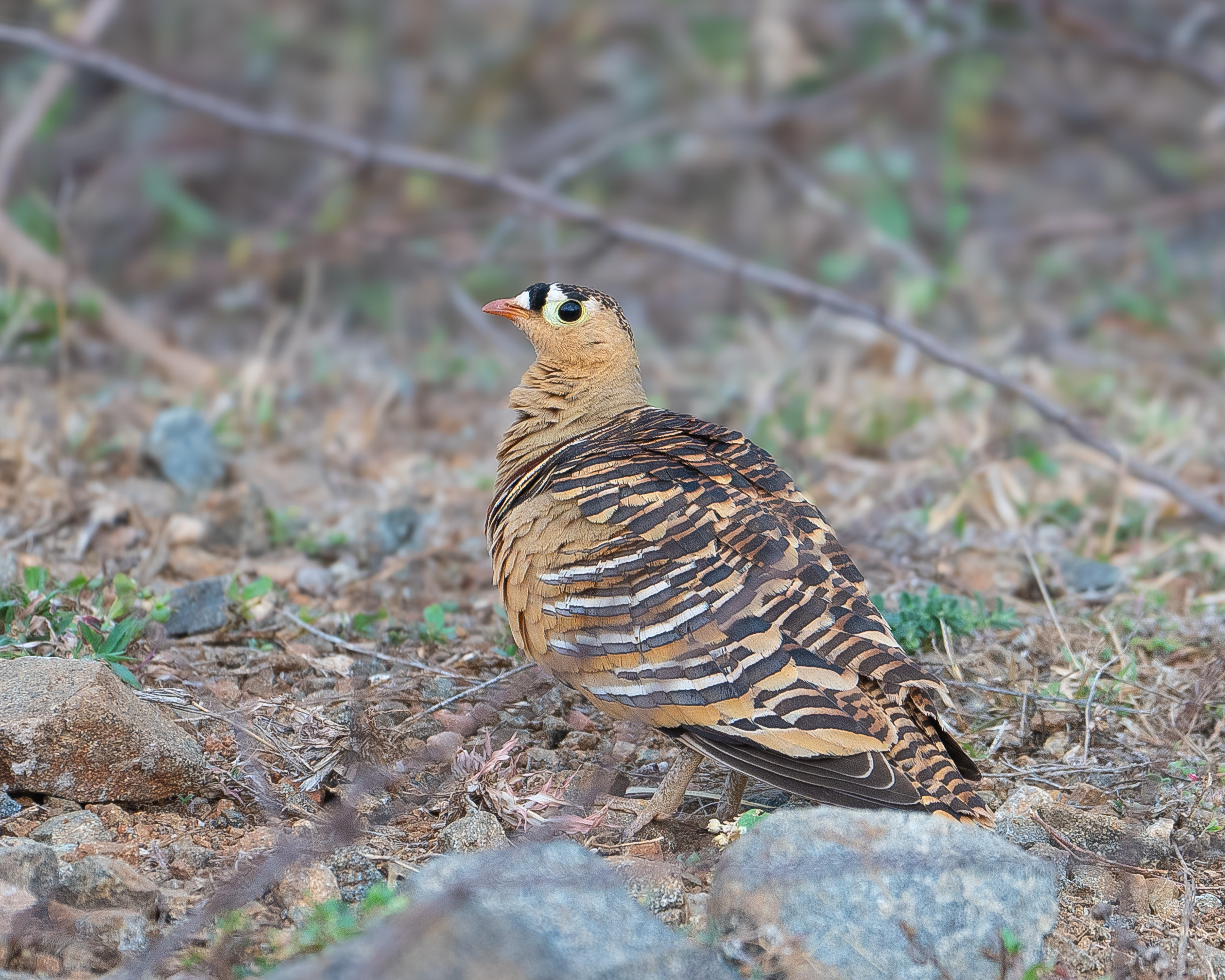
The vehicle veered off the main road and started following a dirt track that took us to the top of a hill. Once again, I became the main “spotter” as I pointed out a family of jungle quails scurrying to take cover, a total of 8 individuals, including a few adorable tiny chicks. As we tried to take a better look at the quails, a sudden fluttering sound caught our ears, very close to the vehicle. Two beautiful birds took flight, right below our noses.
“Painted sandgrouse!” I cried out. The masters of camouflage!
We had seen these fascinating birds in Hampi around 8 years back, and since then I had been harbouring a hope to see them again. We had scoured many scrublands but had no luck. Until that day in Galibore, in an unscheduled safari.
As the vehicle moved ahead, there were more fluttering noises around us, as more birds took flight.
“But how could we miss seeing them even when we were so close?”
The birds’ ingenuity dumbfounded us. The trick, we later realised, was to look for that gorgeous necklace around the male’s neck – a dead giveaway. Their trick, in turn, was to press themselves to the ground, hiding the necklace, and freeze as we approached.

Painted Sandgrouse


With the sun setting, we spotted several of these sandgrouse pairs as they prepared to roost for the evening. We watched on, awestruck, as the male turned round and round rhythmically at the chosen spot, making a cozy “bed” for him and his lady to rest upon. Finally, we bade them a good night and left for own cozy tent in the camp. An amazing afternoon, indeed!
Here come the owls!
The next morning, Govind, our naturalist, took us along the riverside for birding. He pointed to us a small mound where a jungle cat had done its business and covered that up. Pugmarks of sloth bears dotted the dusty ground. We heard the warning call of a deer and sure enough, there were fresh signs of wild dogs (dhole) marking their territory, by the roadside. Meanwhile, doves, cuckoos, robins, sunbirds, ioras, bee-eaters – both green and blue-bearded, and the ubiquitous bulbuls filled the morning birding scene.

Verditer Flycatcher

Common Hawk Cuckoo

Blue-bearded bee-eater
But somewhere I felt we were missing something.
“Where are the owls?” I asked. Owls were my favourites.
Govind knew just the right places. While a male brown fish owl glared at us from his nest, a feisty jungle owlet led us fairly on a merry dance. The moment we thought it had settled down on a tree by the river, it would immediately fly towards the road and choose a tree there. We would then run to the road and by then the owlet would fly to the riverside. Finally, after a few back and forth running, we realised there were two of them having fun with us!

Jungle Owlet

Brown Fish Owl
On returning to the camp, a staff member informed us that a pair of brown hawk owl, or the boobook, had arrived. So had the scops owl family! We were thrilled to see the scops owl young ones, a first for us, peering at us curiously. The brown hawk owl, with its comic wide-eyed expression, and the scops owls were our regulars in Galibore and it was like meeting old friends before we left.

Young ones of Indian Scops Owl

Brown Hawk Owl or Boobook
Bidding au revoir
It always saddens us when we have to pack up to leave. “This trip seemed so short,” is the single refrain, each time. Our hearts, on the other hand, were full. While we had our expectations fulfilled, it was with a tinge of disappointment that we felt the camp needed some improvement in upkeep. The large number of monkeys were definitely not helping the cause.
As we were walking towards the car, I took a final glance at the fallen Arjuna tree. It was then that I noticed that the tree was still growing fresh, new leaves! The base of the tree was bearing small new branches. It was alive! Maybe in a few years the small branches would become stronger, and a “new” Arjuna tree will stand in the same place. If the tree is not cleared off entirely, by then.
In the meantime, Cauvery Wildlife Sanctuary, with its vast repository of species, will remain a special place. Hopefully, this pristine stretch of forest continues to retain its charm for years to come. Till the next visit, then, au revoir!




Leave a Reply