
It was with a slight trepidation that I plonked myself on the hapless Ustaad, the pony assigned to me. I hoped he was in a better mood, having had his fill of jaggery, and maybe it would be an easier climb to the top in the second half than the initial part of the journey.
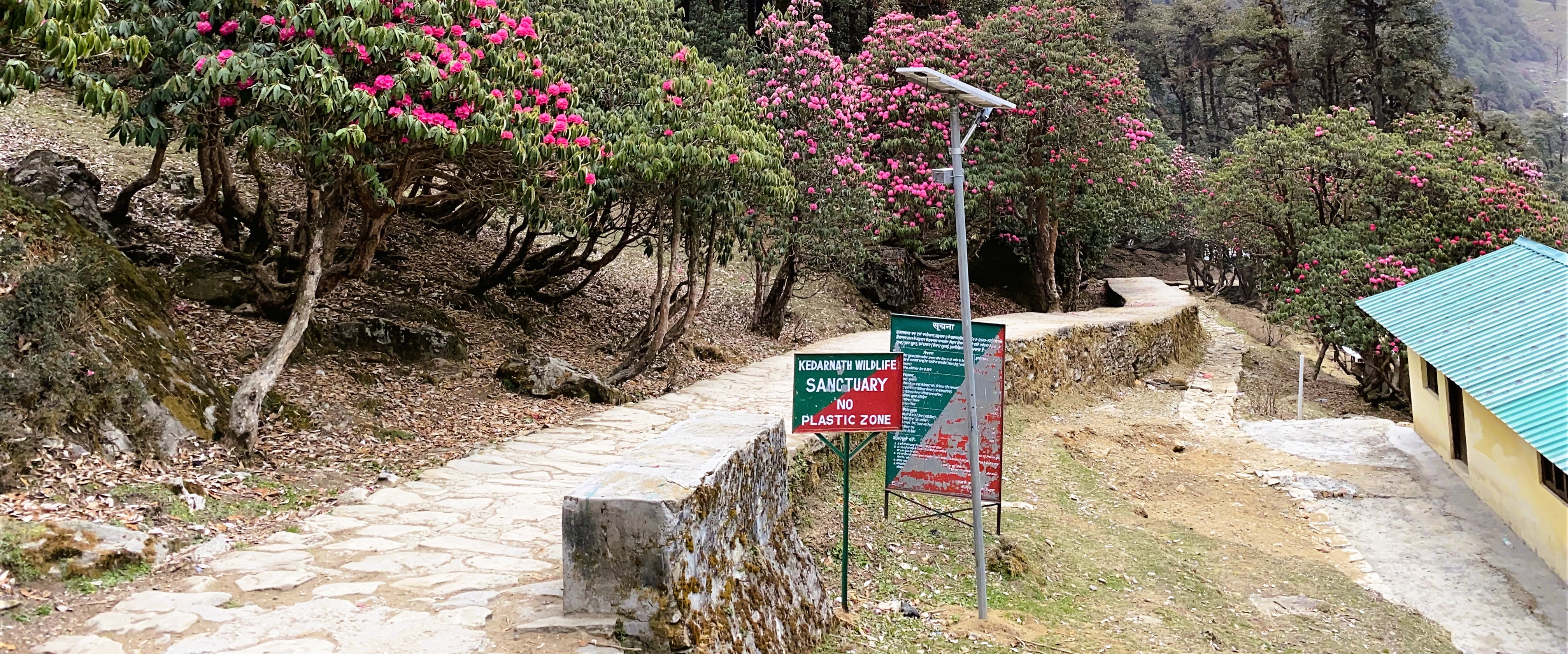
Much to my relief, the sun had ascended well above the horizon, and its comforting rays dissipated some of the morning cold that had left us quite frozen. Soon, I was lulled by the musical clop-clop of the hooves on the cobbled pathway. The hillside sloped away gently to our left and we could see Monal pheasants sauntering amongst the scrubby vegetation, just as our desi chicken would do in the villages. Tiny flashes of iridescent blue flitted amid the thawing blades of dry grass. I recognized the plucky fellow as the Himalayan Bluetail, another gem of the region.

A beautiful beast of burden

A bold and bright Himalayan Bluetail
We could finally see our destination as the gleam of a tin roof twinkled in the distance. In another fifteen minutes we had reached the abode of Lord Tungnath, the highest Shiva temple at a height of 12,070 feet. Bidding goodbye to our ponies, we walked up to explore the small town that had sprung up near the temple. The place was empty, with all the stores and dining establishments closed since the deity was still in Makkumath, where the Lord resides during the harsh winter season.

Nearing the summit

Saw this sign pointing towards Akash Kund, a waterfall located 50 feet below the Tungnath temple.
We were starving and luckily encountered a person opening his small eatery. Soon, our husbands and the bird guides, who were on foot, joined us and our happy chatter broke the forlorn quietness of the place.
Here are some of the bird images that the husband had clicked on the way to the top. (The previous post has quite a few, too.)

A coal tit (aka black-crested tit)

A black and yellow grossbeak, covered in pollen, busy scouring rhododendron blooms


Meanwhile, something wonderful happened in the eatery. On understanding that the owner had no one to help him, our bird guides immediately doubled up as his assistants, rolling up their sleeves to make dough for the paranthas we had ordered. What a beautiful spirit of brotherhood, witnessed on that cold morning in the deserted Tungnath premises! Minutes later, our tables were laden with piping hot plates of spicy Maggi and aloo paranthas, fresh off the smoky tawa. It was one of the best breakfasts that I had in Uttarakhand.

Hot and spicy Maggi in the mountains hits different

A gentle giant – the pahadi Bhotia dog
Satiated, we walked up to the locked Tungnath temple, the stone-paved path slippery with ice. Icicles dangled perilously from the overhead edges, while the antics of the yellow-billed choughs (aka alpine choughs) threatened to dislodge them at any moment. The temple itself, believed to have been built in the 8th century AD by the King of Kannauj, wore a desolate look, yet the vibrant colors stood out against the otherwise grey, rocky backdrop.

Tungnath temple (locked)

April is when the snow starts to melt, leaving behind these icicles
As I mentioned in my previous post, we were not there on a pilgrimage but on a quest to see some of the elusive Himalayan bird species. After an hour of exploring the area, searching particularly for snow partridges, we decided to start our descent. By then, a steady trickle of trekkers had appeared, and the lone eatery had its hands full. Ominously, dark clouds had started to gather overhead. While my friend and our kids chose to ride ponies downhill, I decided to descend on foot, hoping to reach the bottom of the trek before the skies opened up.

Small structures or shrines of other Gods

Interesting rock structures along the way
In contrast to climbing up, going downhill was a significantly more enjoyable prospect. There were benches placed by the side of the path and I took frequent breaks, relishing the beauty of the magnificent peaks, the green meadows and the brilliant rhododendron blooms. Himalayan griffons circled overhead, at times joined by a lammergeier (aka the bearded vulture), and while I had left my camera with our bird guides, it was still pleasing to see these giant birds of prey in such large numbers.
Once, as I sat down to catch my breath, I saw something stirring near my feet. A cute little pika – a small high-altitude mammal, which was quite a frisky fellow. I had seen some the previous day, scurrying up and down rocky crevices, but it looked more adorable up close! I would have liked to spend some more time amidst such wonders of nature but the menacing rumblings from above urged me to quicken my pace and move forward.

Spot the pika!

The imposing Himalayas
Soon, as I reached the lower section of the trek, the parts that I had dared not raise my head to appreciate while climbing uphill on horseback, left me breathless with their beauty. It was akin to walking through an enchanting forest, with myriad hues of the rhododendron and birdsongs accompanying my every step. I couldn’t resist expressing my gratitude for being fortunate enough to witness such a magnificent natural spectacle. Who knows if I would be able to undertake this trek again in the future?
“Madam!” A loud cry made me turn around. It was my ponywala leading his customer on Ustaad’s back. “You ditched us. We could have brought you back!” Ustaad let out a disgruntled “Hrrmph!” I was sure he did not share his owner’s sentiments. In any case, by then, we had reached the entry/exit gate to the Tungnath trek.
And thus ended my Tungnath trek. A bagful of memories, a treasure trove of experiences that I will cherish forever. Maybe the next time I could offer my thanks to Lord Tungnath in his own abode.



Leave a Reply