
There’s infinitely more to Gopinatham than what I had written about in my last post. The Gopinatham Mystery Trails camp by Jungle Lodges & Resorts (JLR), where we had our accommodation, offers jungle safaris in the afternoon and if you are not hankering after a tiger sighting, there’s enough in the forest to keep you charmed. But let’s not get ahead of ourselves.
Before embarking upon the jungle safari later in the day, we were treated to a resplendent dawn. Village roosters let out boisterous wake-up calls, and faint melodies emanating from the neighbouring temples reached our ears. A fine mist hung around the coconut trees, dissipating as the sun rose over the horizon gently. A whiskered tern and a few river terns whirled above the lake while a flock of cormorants arrived to take up the best seats around it.
At the far end of the lake, the deity of Lord Ayyanar stood vigil over the village, his trusted white horse beside him. It is said that Veerappan would periodically venture out of his hiding to pay obeisance to the guardian God of the village.

Dawn breaks over Gopinatham

The village guardian lord keeps vigil

A lone whiskered tern circles over the lake
Living down the scars of the past
Gopinatham is nestled amidst the Cauvery wildlife sanctuary, the forest range accompanying the Cauvery River as it meanders towards Tamil Nadu. The serenity of the jungle belies the deep upheaval that it had witnessed during the violent period spanning Veerappan’s rule. The conflict between the jungle brigand and the special task force that was employed to capture him had led the wildlife into hiding during those years of turmoil. While their numbers have increased over the years with peace returning, a sense of insecurity still shrouded them.
Because, memories may not last long, but instincts do.

A majestic Indian Gaur on guard
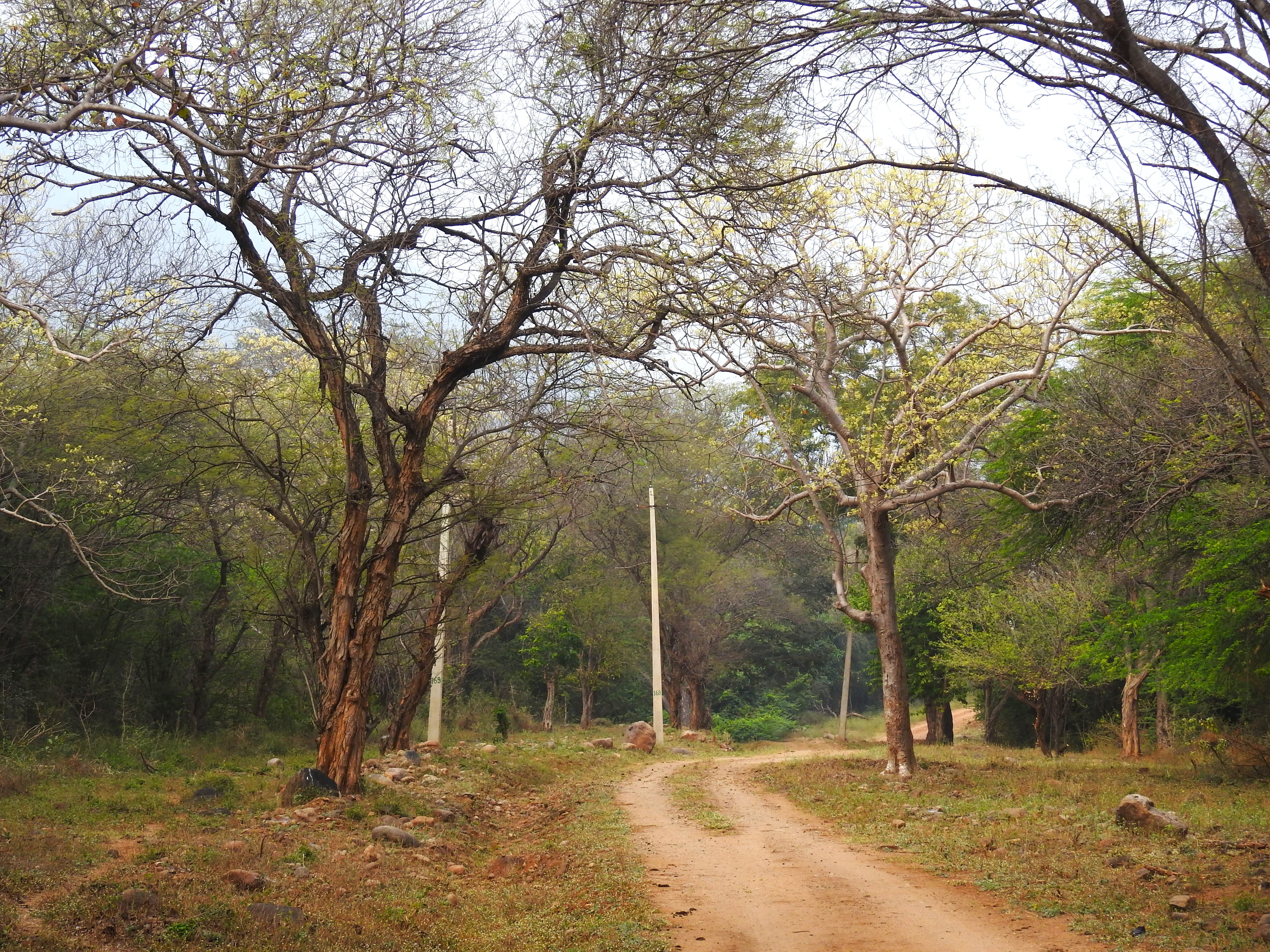
No wonder, the herds of spotted deer and Indian Gaur we came upon, pricked up their ears and took to their heels the moment our vehicle was in the vicinity. Elephants remained wary and at a distance, trumpeting loudly as they shielded their young ones. At one spot, we heard elephants bathing in the stream, but they left before we could click any photos, heeding the matriarch’s warning. While the safari did not yield any sightings of the big cats, the fact that predators prowled the forest in the dark was substantiated by leopard pugmarks and scat that we observed on the jungle track.
A forest of upside-down trees
The late northeastern monsoon had lent a green cover to the forest even in January, and the MM hills range continued to remain by its side throughout the safari – a giant fortress protecting the wildlife sanctuary custodially. A number of streams criss-crossed through the jungle, keeping its residents satiated. Although the Cauvery region is known for its beautiful Arjuna trees, what amused me more were the Helicopter trees (Gyrocarpus Americanus) that were waiting for new leaves to shoot forth.
With their numerous, bare outstretched branches facing skywards, I thought the name ‘upside-down’ trees suited them more than the intriguing ‘helicopter’!

Helicopter trees, or as I like to call them – the upside-down trees!

The hills are always around
Stories in rock carvings
The jungles of MM Hills/Cauvery WLS hold as many mysteries as it does the stories of Veerappan. Along the safari route we came across some interesting rock carvings that we could only see from a distance, without alighting from the vehicle. One of them was a beautiful rendition of Lord Hanuman, with faint traces of vermillion perceptible in the figure. While there was no concrete proof, it is believed that the carving dated back to the rule of the Mysore Maharaja who would frequent these jungles for shikaar. The staff accompanying the Maharaja in the hunt were staunch worshippers of Lord Hanuman and hence, they decided to engrave his image in the rocks during their period of stay, invoking his protection. With time, the people inhabiting in the jungle area came to revere the figure and so it has continued till present day.
Another piece of rock carving lay off the track in wilderness, its artist unknown and the figurines unworshipped. Carved onto flat slabs were figurines of a man combating a tiger, above which was etched a smaller figure who sat worshipping a Shiva Lingam while Nandi looked on. Perhaps these, too, were of the same period as the previous one, but belonging to a sect that worshipped Lord Shiva.

Carving of Lord Hanuman

Stories etched on rocks
Hopefully, these ancient carvings will receive due attention and would be preserved conscientiously for the coming generation.
An angry Daiva and the arrogant British officer
Driving through Gopinatham, in an adjacent village, we were shown a dilapidated structure that once used to be the village temple. The story goes that a powerful Daiva (guardian spirit) resided in the temple during the times of British rule. Once, a British officer came to the village, piqued by the fame of the temple. In his arrogance, deeming the villagers as simpletons, the officer entered the temple without taking off his shoes. Angered by the insolence shown by the man, the residing deity left the temple. The aggrieved villagers pleaded with him and built him a new temple atop a neighbouring hill where he is worshipped presently.

Remnants of the abandoned temple
“Would you like to enter the temple and take a look inside?” asked the young naturalist accompanying us. I firmly shook both my hand and my head, not willing to summon the anger of any other remnant spirit in the abandoned structure!
The mysterious predator of the night
Later, we were watching a wildlife documentary in the evening, as per JLR’s itinerary, when our naturalist came running to our side.
“There’s a snake devouring a lizard near the kitchen!” he said.
Unlike at the temple, we didn’t need any encouragement here. We immediately rushed to the camp’s kitchen where an amazing sight unfolded before us. A snake, around a foot in length, was busy gorging on a hapless, good-sized garden lizard at a hectic speed and was nearly done with it. The lizard had come to prey on moths and other insects that had settled down on the wire mesh behind the kitchen. Unluckily for the fellow, it turned out to be dinner for the snake itself.

Hazy pic of the unidentified snake. A Sri Lankan flying snake?
Interestingly, that snake had not been seen in the area previously and the head naturalist of JLR suspected that it might be a Sri Lankan Flying Snake (aka Indian Flying Snake). If it was, it would have the first record of its sighting in the region. The staff at JLR was advised to keep a lookout for the snake and a better photo taken of it to confirm its identity. Mysteriously, the snake disappeared that night and was not reported again.
A rare appearance
Besides the safari, another way to see the beautiful jungle was on foot. After a thrilling evening, we opted to go on a guided nature-walk in the morning. We walked through cattle-trodden pathways lined with oil cake trees (Albizia amara), that were apparently a favourite of the elephants during the dry season. The woods rang with the tak-tak-tak of woodpeckers beginning an early day at work.
“Hopefully, you will get to see the star bird of our area,” said our naturalist. “The white-naped tit.”
The endemic white-naped tit is a rare species and can be found sporadically in only a few places in the country, the Cauvery WLS being one of them. We had earlier seen a glimpse of the bird at Galibore Nature Camp, another JLR camp along the Cauvery, and kept our fingers crossed for a better look this time around.
We were not disappointed.

The rare white-naped tit
It announced its arrival with its signature chirp and soon we were craning our necks to locate it amongst the acacia branches. Although the view was obstructed, it was still a joy to watch it flit from bough to bough.
The morning was well spent, and we ticked off a number of bird species on our list, a lifer being a grey-breasted prinia that we had nearly overlooked. Here’s a look at some of the birds that we clicked:

Yellow throated sparrow

Black-naped Monarch

Lesser goldenback

Brown-capped pygmy woodpecker

Grey-breasted Prinia
And with that, our visit to Gopinatham Mystery Trails came to an end. We departed with a greater number of mysteries on our hand than we had anticipated resolving, wondering who had made those beautiful carvings in the forest, those designs on the flower petals, that unidentified snake. Should we make another trip to Gopinatham to find the answers to our unsolved mysteries, then? What do you reckon?

Read the first part here:


Leave a Reply